Code of Research Integrity & FAIR
From 2026, the FAIR principles are integrated into the Danish Code of Conduct for Research Integrity as a central foundation for good scientific practice and responsible data handling.
Responsible research data management involves handling research data in accordance with the FAIR principles (Findable, Accessible, Interoperable, Reusable). From 2026, the FAIR principles are included in the Danish Agency for Higher Education and Science's Danish code of conduct for research integrity as a central foundation for good scientific practice and responsible data management. The FAIR principles aim to ensure transparency, quality and reusability of data throughout the research process.
Data management is a central part of the research process and should be supported by a clear organizational framework and relevant research infrastructure. DeiC plays a central role as a national provider of tools, services and competencies that support the work with FAIR data management. Below you can read more about how the FAIR principles are included in the research process and what tools DeiC provides.
FAIRification as part of the research process
The figure below illustrates FAIRification as a coherent and iterative process of translating FAIR principles into concrete practices throughout the data lifecycle. The process begins with clarifying the purpose and rationale for FAIRification and continues through defining data elements and relationships, preparing metadata, and selecting software, hardware, licenses and persistent identifiers (PIDs). This is followed by hosting and publishing the FAIR data and metadata, before the process concludes with an assessment of the extent to which the data meets the set goals.
The process reflects the recommendations for research data management described in the Code for Integrity in Research.
The Danish Code of Conduct for Research Integrity was last updated and published in January 2026 by the Danish Agency for Higher Education and Science. In its introduction, the code states:
"The Danish Code of Conduct for Research Integrity provides the research community with a framework for promoting common principles and standards and supports a common understanding and culture of research integrity in Denmark."
The code has been developed in collaboration between all Danish universities. Research data management is covered in a separate section where responsibilities, roles and requirements for handling research data are clarified.
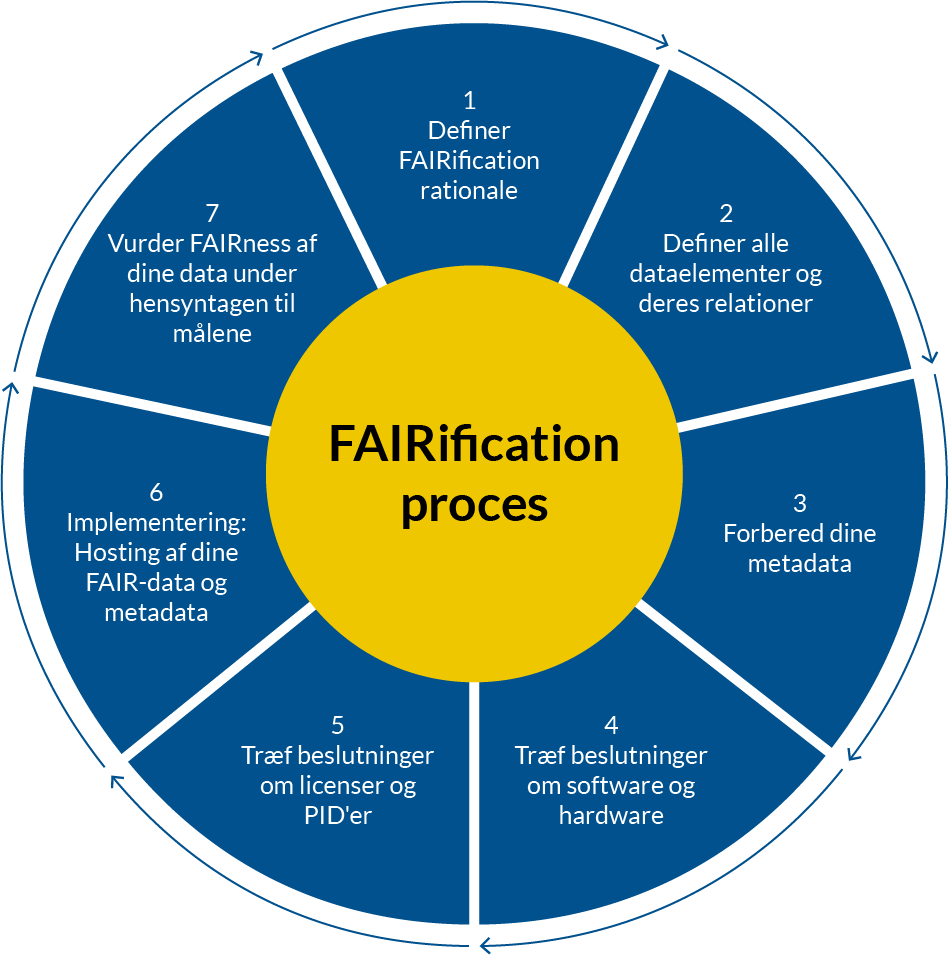
Define FAIRification rationale
Why should your data be FAIR? Which datasets do you want to start with?
Define all data elements and their relationships
What kind of data do you have? How much data do you have? Use DeiC DMP to write your data management plan
Prepare your metadata
What metadata is needed to describe my data? Is there domain-specific metadata I need to use?
Tools:
- Metadata standards directory
- Repository of your choice (for instance DeiC Dataverse, or institutional repository)
Make hardware and software decisions
Does my university have a storage solution for pre-publication data?
After publication, should I place my data in a general repository or in a domain-specific one?
Tools:
Ask researcher support / Front Office if you are unsure which solution you should use. You can find contact information for Front Offices here
Make decisions about licenses and PIDs
Who should be able to reuse my data? How do I ensure that data can be easily found and identified?
Tools:
Implementation: hosting your FAIR data and metadata
Do you have all the necessary information to upload your data?
Can you make it easier for yourself by using an API to automate your upload?
Tools:
Depends on the repository you have chosen - take your time and avoid rushing the process.
Assess the FAIRness of your data taking the goals into account
Is your data FAIR enough? Is there room for improvement?
Tools:
Research data management in the Code
(Section 3.1, page 15)
i. About data management plans (DMP)
Data management plans should be developed that, as a minimum, provide insight into what research data can be made publicly available, and how and where data is planned to be stored and preserved.
DeiC support:
ii. Storage, preservation and management of data and metadata
Research data and metadata should be stored, preserved and managed in a clear and concise form according to FAIR principles and subject to necessary data access restrictions.
Metadata should enable the identification of the individuals who conducted the research and the individuals or institutions responsible for the data and research results. Metadata underlying the publication should contain a precise and traceable reference to the source in the form of a PID (Persistent Identifier).
DeiC support:
Institutional and individual responsibility
The overall responsibility for research data management lies with the institution. Institutions must:
- provide secure facilities for data storage
- ensure compliance with confidentiality, integrity and accessibility requirements
- support researchers to store and preserve data responsibly
Researchers should contact their university front office for information on national and local solutions for research data management.
Training and skills development
Training programs for PhD students and postdocs should include education, training and guidance on research integrity, including research data management based on the FAIR principles.
Researchers should contact their university front office for information on national and local training and skills development opportunities.
- Council of the European Union (2022). Council conclusions on principles and values for international cooperation in research and innovation.
- Danish e-Infrastructure Cooperation (DeiC) (2021). [National strategy for data management based on FAIR principles (2021)
- Danish e-Infrastructure Cooperation (DeiC) (n.d.). E-learning course in research data management (RDM)
- European Commission (2016). Guidelines on FAIR data management in Horizon 2020.
- European Commission (n.d.). Open access and data management
- European Commission (n.d.). Open access and data management. https://ec.europa.eu - GO FAIR Initiative (2016). The FAIR guiding principles for scientific data management and stewardship
- Danish Agency for Higher Education and Science (n.d.). Research integrity
- HowToFAIR (n.d.). How to FAIR